

Putting knowledge into action
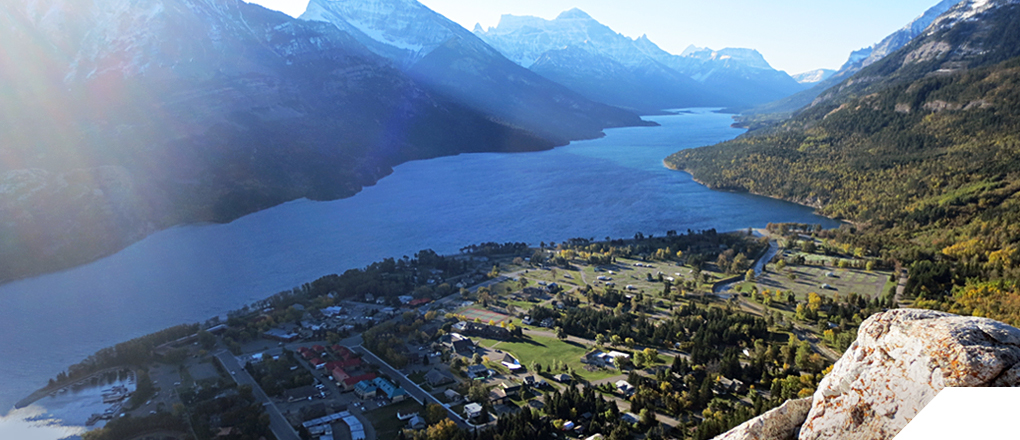
We envision a world where communities have genuine access to the science and research they need to make choices that promote healthy landscapes. We study the landscape in order to help people conserve it.

This past year was one of transition and change for the Miistakis Institute. We moved to Mount Royal University (MRU) and established ourselves as MRU's inaugural affiliated institute. While most moves tend to be stressful, exhausting and chaotic, our move to MRU proved to be relatively stress-free making for a seamless and smooth transition. Much of this was due to the support and warm welcome we received from MRU. We have enjoyed getting to know our MRU neighbors and colleagues and look forward to meeting more of the MRU community.
We have spent a lot of time over the past few months meeting new people, sharing who we are and what we are all about. This has made us consider how we describe what it is we do. For those of you who know us, you may know us for our expertise in one of our key research areas. For those of you who don't know us yet, we get knowledge into the hands of people who can actively use it in support of conservation. This is often referred to as Knowledge Mobilization or Knowledge Brokering.
Natural resource and land managers frequently state that they need decisions to be scientifically based. Scientifically robust information is being sought more and more by all types of land managers and stakeholders. These groups include: provincial environment agencies, private land owners, parks departments, municipalities, and land trusts. This sounds straightforward, but it challenges everyone involved in conservation research and management.
It is not enough to provide decision makers with data sets, maps, charts, graphs, or even peer-reviewed articles and executive summaries. "Knowledge" is not truly made available until it is in a usable form for those decision makers, in the place and time they exist. Context matters because it allows different groups to use the same knowledge - but in different forms and for different purposes.
This requires understanding the research - how it was developed and its validity - while at the same time understanding the conservation issue that people are seeking to address, and then understanding the lens through which those people view the issue. Being a research institute, a conservation charity, and a social enterprise allows Miistakis to play the different roles necessary to broker, transfer or mobilize knowledge. Miistakis is able to take knowledge from the realm of academia to the realm of land and resource management. In this role, Miistakis may scientifically investigate conservation dilemmas, analyze policy implications, develop decision support tools, catalyze community conservation action, or all of the above.
I welcome you to read more about us and our role as a knowledge broker in the following pages of our annual report.
Danah Duke, Executive Director

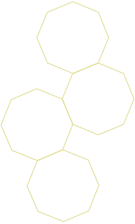
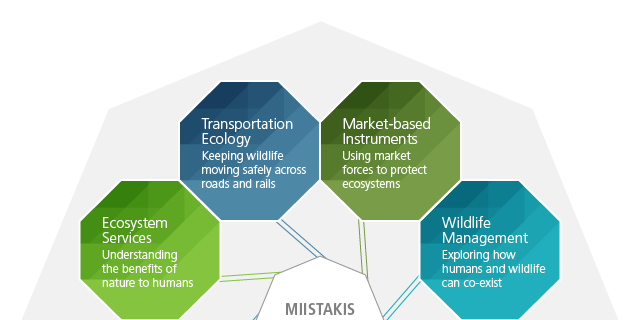
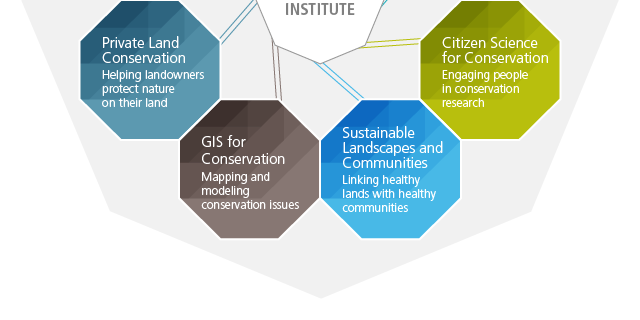
Miistakis focuses our efforts on the following research themes. In all cases, our projects take the same approach: identify the need, define the problem and solve the problem.
Click on a research area in the diagram below to learn more.

Transportation Ecology
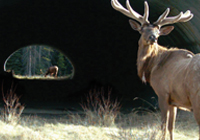
Transportation infrastructure across the world poses numerous environmental challenges that affect our air, landscapes and water. From a landscape perspective roads and railways cause wildlife mortality through collisions and also act as a significant barrier to wildlife movements. The Miistakis Institute aims to: generate awareness of the challenges that transportation infrastructure poses to wildlife, promote workable solutions to these challenges and generate support for implementing these solutions.
PROJECTS
Highway 3 Transportation Corridor Project
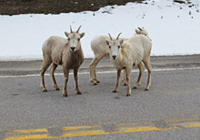
Helping wildlife cross a busy transportation corridor is a winning proposition for improving both human and wildlife safety. Working with Y2Y, WTI and Road Watch in the Pass, Miistakis is engaging with key government agencies (including Alberta Transportation and Alberta Environment and Sustainable Resource Development) to develop informed strategies and implement actions to reduce wildlife vehicle collisions and improve human and wildlife safety at two key wildlife crossing locations along southern Alberta's busy Highway 3.
Thematic Areas
Transportation Ecology, Wildlife Management
Partners
Western Transportation Institute, Yellowstone to Yukon Conservation Initiative (Y2Y), Road Watch in the Pass, Alberta Transportation, and Alberta Environment and Sustainable Resource Development
Market-based Instruments
Ecological conservation and economic development are not mutually exclusive. Although markets have traditionally been a powerful force for confounding conservation, they can be, and increasingly are, a powerful force for supporting it. At Miistakis we work to identify market-based approaches that support conservation, then we work to create the policy and tools that will bring these approaches to fruition.
PROJECTS
Using Payments for Ecosystem Services to Protect Native Grasslands
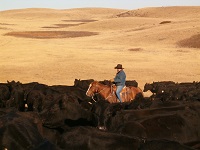
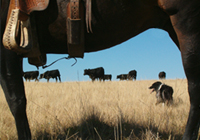
Natural grasslands are on the decline on a global scale, yet on an ecosystem services scale they provide water cycling and regulation, pollination, habitat, climate regulation, food, spiritual and cultural value. Though extensive grazing may be compatible with natural grassland functions, it may not have as high of an immediate economic return as other more intensive land uses. Payment programs based on the provision of ecosystem services can be used to recast the traditional market, thus providing necessary economic weight to grassland conservation. The Ranchers Stewardship Alliance and Nature Saskatchewan asked Miistakis to evaluate existing Payment for Ecosystem Service (PES) programs from around the world that have applicability to livestock production in grassland ecosystems. Programs in the Netherlands, Sweden, Germany and the United States were reviewed to uncover successful attributes and lessons learned. From these, Miistakis created recommendations for designing and implementing successful PES program for livestock producers managing conservation grasslands in the northern Great Plains of Canada.
Thematic Areas
Market-based Instruments, Ecosystem Services, Sustainable Landscapes and Communities
Partners
Ranchers Stewardship Alliance Inc., Nature Saskatchewan and funded by Coalition for Environmental Cooperation
Photo credit: M. Burgess
Wildlife Management
In today's changing landscape it is often challenging for wildlife to coexist on the landscape with humans. Human developments including housing, agriculture, industry and recreation infringe on wildlife habitat and movement areas. By using the best available science, wildlife management attempts to balance the needs of wildlife with the needs of people using the best available science. Miistakis is interested in examining the ways to improve the coexistence of humans and wildlife. This often includes determining wildlife needs, assessing human impacts to wildlife habitat and exploring adaptive management for both humans and wildlife.
PROJECTS
Leave It To Beavers - Watershed Stewardship at the Ann and Sandy Cross Conservation Area
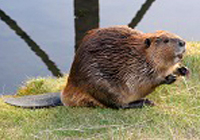
Every year, across the province of Alberta, many hundreds and likely thousands of beavers are shot or killed through the use of traps. This is because beavers are responsible for causing flooding and other property damage. However, beavers are now increasingly recognized for their important roles in ecosystem health including water retention, groundwater recharge and improved water quality. Miistakis is working with the Ann & Sandy Cross Conservation Area (ASCCA), Cows and Fish and the Calgary Science School to document the watershed changes at the ASCCA following the reintroduction of beavers as a watershed stewardship tool.
Thematic Areas
Wildlife Management, Citizen Science, Ecosystem Services
Partners
Ann and Sandy Cross Conservation Area, Alberta Riparian Habitat Management Society (Cows and Fish), Calgary Science School
Citizen Science for Conservation
Citizens are facing complex conservation challenges. Stronger sustainable solutions engage citizens in better understanding the issue, contributing personal knowledge and experience, and implementation. Miistakis uses a citizen science approach to generate data to inform conservation challenges and create a knowledgeable and engaged citizenry. Miistakis develops tools and frameworks that contribute to successful citizen science projects.
PROJECTS
Wild Watch
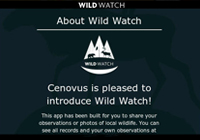
Understanding the impact of human development on wildlife is challenging without timely and accurate data of how wildlife are using the landscape. Engaging employees in wildlife monitoring plays a critical role in fostering wildlife stewardship and has the potential to result in valuable data to inform decision-making. Cenovus Energy asked the Miistakis Institute to develop a mobile app and web-based platform to facilitate the collection of wildlife observations by Cenovus employees. The information gathered from this work can be used to consider how activities affect wildlife at a landscape scale and has the potential for coordination with neighbouring industrial sites and partners.
Thematic Areas
Citizen Science for Conservation, Wildlife Management, GIS for Conservation
Partners
Cenovus Energy
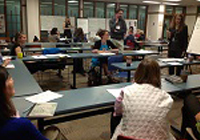
Sustainable Landscapes and Communities
The ecological sustainability of our landscapes cannot be separated from the social, cultural and financial viability of the local communities within those landscapes. Understanding those linkages is critical to maintaining healthy vibrant landscapes and healthy vibrant communities. The Miistakis Institute's research identifies these links, then we develop tools and information to help communities make decisions that support both the landscapes and the communities.
PROJECTS
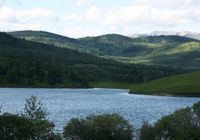
Local Community Adaptation to Climate Change
Climate change is literally a global issue. While local municipalities know it will affect them, it is less clear exactly how and what they can do about it. Working within the Alberta Biodiversity Monitoring Institute-led Biodiversity Management and Climate Change Adaptation project, Miistakis is exploring how research on climate impacts and resilient communities can support Alberta municipalities' emerging use of Climate Change Adaptation Action Plans. The effort involves reframing climate impacts in a way that is meaningful to local governments, linking impacts to effective adaptation strategies and connecting those strategies to existing municipal policies.
Thematic Areas
Sustainable Landscapes and Communities, GIS for Conservation
Partners
Alberta Biodiversity Monitoring Institute (ABMI), University of Alberta, Alberta Innovates - Technology Futures, Government of Alberta, and Climate Change Emissions Management Corporation
GIS for Conservation
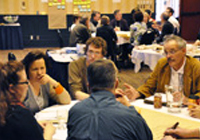
GIS is more than just maps. Virtually everything we do at Miistakis has some GIS component. Our work involves: publishing maps to share ideas or research results, analysing data to add a dimension to our understanding of complex challenges, creating new data sets to fill critical gaps, or designing map-based applications that users can interact with to explore the spatial context of conservation questions, or even contribute their knowledge to our improved understanding of local issues. Miistakis aspires to create maps and data that are useful and accessible to a broad range of users, as well as map-based tools that are intuitive, replicable and adaptable to a broad range of conservation applications.
PROJECTS
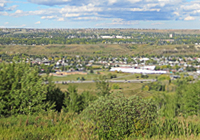
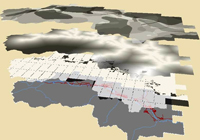
Mapping Ecological Connectivity in the Calgary Region
"Connectivity" is a paramount consideration for conservation, but what does it actually mean, and how do we measure or map it meaningfully? Answers to these questions often focus on one or two species, rely on costly data collection and produce results that favour precision at the expense of landscape-level understanding. A research collaborative involving both of Calgary's universities and the Miistakis Institute has chosen a different approach: working to understand ecological connectivity on a non-species-specific, regional landscape scale. The model uses coarse, widely-available data and a general understanding of landscape ecology to map the permeability of a landscape, highlighting networks of connectivity, and even predicting relative importance of different hubs and connecting paths. The Calgary Regional Partnership will use the results of this research in evaluating their Calgary Metropolitan Plan, which is a key determinant of future land use in and around Calgary.
Thematic Areas
GIS for Conservation
Partners
University of Calgary - Faculty of Environmental Design, Mount Royal University - Institute for Environmental Sustainability, Calgary Regional Partnership.
Private Land Conservation
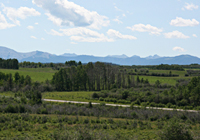
Much of the land critical for wildlife habitat, water cycling, nutrient flows and other ecological processes across the broad landscape is privately held. Land trusts and municipalities are working to ensure critical parcels of land continue to play these important roles. Miistakis supports both the individual organizations and the private land conservation community, including landowners, by providing necessary research services; tools; resources; and planning, management and policy assistance.
PROJECTS
Policy Review of Conservation Easements for Agriculture
Although Alberta conservation easements can now be used to protect private agricultural properties, the policy intent is unclear. The Alberta Land Use Secretariat asked the Environmental Law Centre and Miistakis to review this policy gap and make recommendations that could help new and existing land trusts effectively use this newly-expanded conservation tool. The review explored the legal and policy context, the experience of other jurisdictions and the challenges and opportunities for program delivery, ultimately providing a series of policy-related recommendations for the Government of Alberta addressing questions of purpose, structure and delivery for conservation easements for agriculture.
Thematic Areas
Private Land Conservation
Partners
Environmental Law Centre, and Alberta Land Use Secretariat
Ecosystem Services
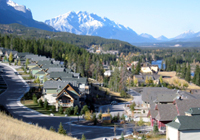
Human well-being is based heavily on the benefits we derive from nature or ecosystem services. That utilitarian view is fast becoming a dominant framework for conservation of our natural systems and is embraced by a range of people from policy makers to landowners. Miistakis is working to understand how this particular approach to valuing nature can best be used to conserve nature.
PROJECTS
Ecosystem Services Assessment for Environmental Innovation and Competitiveness
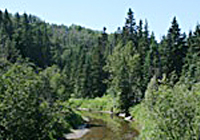
To better understand the supply and demand of ecosystem services in Alberta, researchers at the Alberta Biodiversity Monitoring Institute (ABMI) and Green Analytics are modeling freshwater provisioning, water purification, timber production, rangeland forage production, pollination, carbon sequestration and biodiversity intactness. Miistakis is working on this ABMI-led project to create a scoring system for these ecosystem services and a portal delivery system that will put this information in the hands of land and resource managers who need it.
Thematic Areas
Ecosystem Services and GIS for Conservation
Partners
Alberta Biodiversity Monitoring Institute (ABMI), Green Analytics, Alberta Livestock and Meat Agency, and Alberta Innovates - BioSolutions

Staff
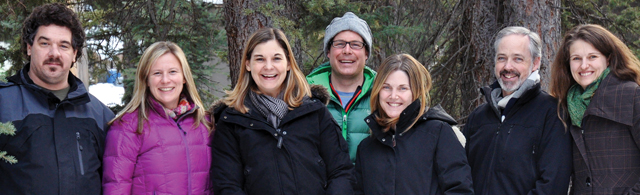 L to R:
Ken enjoys applying his problem solving, computer programming, and GIS skills to Miistakis projects. He has been with Miistakis for 12 years and his work includes managing the IT infrastructure, computer programming for web development and GIS related applications and project management. Most recently he has been working on a project with Cenovus that involves creating a wildlife observation app and a web mapping application. He has also involved in the Leave It To Beavers Watershed Stewardship project. Ken believes that Miistakis fills a void in the steps between research and decision makers. He also thinks that Miistakis plays an important role by providing support that helps other organizations reach their goals.
Greg is passionate about the work he gets to do at Miistakis. With a background in biogeography and GIS, Greg brings a spatial perspective to the questions and problems that Miistakis approaches. He has been with Miistakis for 10 years, and his work includes GIS, remote sensing, mapping and providing technical support for other Miistakis projects. Recently, he worked on two GIS projects that focused on mapping local community and conservation values in order to provide communities with tools they can use to better articulate their values about the landscapes that they inhabit. Greg believes that Miistakis plays a crucial role by acting as a hub between the research and ideas that are generated at academic institutions, and the people who take and apply those ideas to real-world conservation and land use problems.
Guy is passionate about the emphasis that Miistakis places on applied research. With a background in English and creative writing, human geography, environmental design and private land conservation, Guy is interested in the impact that communication has on ecosystem and resource management. Guy has been with Miistakis for 10 years and is involved in land use, private land conservation and communications work. He also contributes the following skills: the ability to connect the broad visionary view with detailed planning and action steps; his knowledge of market based instruments and financial incentives; and his talent for turning ideas into projects. One of the recent projects that he has been involved with is the Biodiversity Management and Climate Change Adaption project. Guy believes that Miistakis's work is important because it genuinely gets scientific and research information into the hands of people who can use it for conservation.
Danah is passionate about combining science and research with conservation. As Executive Director, Danah is involved in all areas of work at Miistakis. She is an inclusive leader who excels at connecting vision to operations. During her 12 years at Miistakis, Danah has been involved with strategic visioning and project development, operationalizing work plans, fundraising, cultivating partnerships, specific project research, financial management, reporting and supporting staff. She believes that Miistakis's role as a knowledge broker between academics/researchers and resource/land managers is crucial to addressing land use and conservation issues.
Kim has always had a deep respect for the work that Miistakis does. Her background in private land conservation and land use, conservation easements, agriculture and psychology enables her to bring a slightly different perspective to the work she does at Miistakis. She has been with Miistakis for six years and her work involves private land conservation, ecosystem services and human-wildlife conflict. Some of the projects that she has worked on include the Transfer of Development Credits project and the Grassland Stewardship project. Kim believes that Miistakis's private land conservation work is valuable because it assists with the transfer of information and knowledge in ways that help people to make informed decisions. She also feels that Miistakis plays a valuable role by bringing forth new and innovative ideas that promote conservation.
Tracy developed a passion and appreciation for citizen science during her past experiences in Africa. She completed her master's degree through Miistakis in a citizen science project called Road Watch in the Pass. Some of the areas that Tracy has been involved in during her 15 years at Miistakis include project development, fundraising, analysis and GIS. Citizen science, wildlife management and transportation ecology are the main research areas that Tracy is involved with. Some of the projects she has worked on include Road Watch In The Pass and the Highway 3 Partnership Report. Tracy feels that the work Miistakis does is important because it involves applied conservation research that informs better land use decisions, choices and decision-making policies. She also thinks that Miistakis plays a valuable role by producing knowledge that helps communities to make more informed decisions and choices.
Rachelle is interested in telling Miistakis's stories about conservation. After partnering with Miistakis to complete her master's degree research, Rachelle began working full-time with Miistakis in 2010. She has a background in watershed stewardship and her skillset includes social science and facilitation experiences. In addition to helping maintain communication tools such as Miistakis's e-newsletter, Twitter stream and annual report, Rachelle is also involved with citizen science projects. Her contributions include: working on the Leave It To Beavers Watershed Stewardship project; the Highway Wilding project; and work done with Payment For Ecosystem Services. Rachelle feels that Miistakis plays a valuable role by taking existing information and making it accessible to people who are making tough decisions about the future of Alberta's landscapes and wildlife.
Partners
Alberta Beef Producers
Alberta Biodiversity Monitoring Institute
Alberta Conservation Association
Alberta Ecotrust Foundation
Alberta Environment and Sustainable Resource Development
Alberta Innovates - Bio Solutions
Alberta Innovates - Technology Futures
Alberta Land Trust Alliance
Alberta Land Use Secretariat
Alberta Livestock Management Agency
Alberta Motor Association
Alberta Public Lands
Alberta Real Estate Foundation
Alberta Toursim, Parks and Recreation
Alberta Transportation
Alex Taylor
Anatum Consulting Ltd.
Anonymous Foundation
Beaver Hills Initiative
Bow Valley Naturalists
Calgary Regional Partnership
Carolyn Haddock
Clay Graphic Design
Climate Change Emissions Management Corporation
Cows and Fish
Crown Managers Partnership
Crown of the Continent Conservation Initiative
Donner Canadian Foundation
Edmonton Community Foundation
Environmental Law Centre
Greater Edmonton Alliance
Annalisa Greenaway
Gwendo Greenaway
Institute for Environmental Sustainability
Kayak Foundation
Land Stewardship Centre of Canada
Livingstone Landowners Group
Rob and Loretta Schaufele
Matt Knapik
Max Bell Foundation
Mike and Dianne McIvor
Oldman Watershed Council
Parks Canada Agency
Patagonia Environmental Grants Fund
Prairie Conservation Forum
Ranchers Stewardship Alliance
Rangeland Resource Management Program
RBC Foundation
Roundtable on The Crown of the Continent
Shell Environment Fund
Small Change Fund
Southern Alberta Land Trust Society
State Farm Youth Advisory Board
Strathcona County
TD Friends of the Environment Foundation
The Ann and Sandy Cross Conservation Area
The Calgary Foundation - Community Grant
The Calgary Science School
Justin Thompson
Town of Canmore
University of Alberta
University of Calgary
Western Transportation Institute
Montana State University
Wilburforce Foundation
Wildlife Conservation Society
Winding River Pictures - Leanne Allison
Woodcock Foundation
Yellowstone to Yukon Conservation Initiative
Directors
Director and Talisman Energy Chair of
Environmental Sustainability
Institute for Environmental Sustainability
Mount Royal University
Marco Musiani, Vice Chair
Associate Professor,
Faculty of Environmental Design
University of Calgary
Rob Senko, Treasurer
Director, Regulatory Economics and Policy
Altalink Management Ltd.
Trevor Davis
AVP Research
Mount Royal University
Professor/Program Director,
Environmental Studies Program
University of Montana
Bill Dolan
Land and Resource Management Coordinator
Southern Region
Tourism, Parks & Recreation
Ian Dyson
Section Head, System Development,
Alberta Environment and Sustainable Resource Development
Robert Parkinson
Manager, Geomatics and Asset Record Management
ENMAX Power Corporation