


Wildlife Information Primer
To help you identify wildlife species in the Crowsnest Pass, click on the list below:
- Grizzly Bear
- Black Bear
- Cougar
- Lynx
- Wolverine
- Wolf
- Coyote
- Bighorn Sheep
- Mountain Goat
- Moose
- Elk
- Mule Deer
- White-tailed Deer

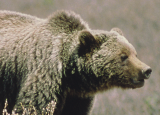
Photo Credit: Houghton Mifflin Company / Courtesy of Brian Patton
The grizzly bear is larger than the black bear. Its snout rises abruptly into its broad, concave face. Grizzlies can be distinguished from black bears by the large hump of muscle on their shoulders, a dished face and longer claws.
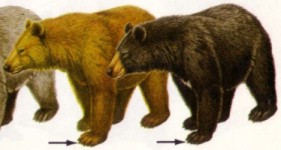
Photo Credit: Houghton Mifflin Company
The black bear comes in a variety of colors including brown, cream and black. Its face is roundish in profile. The snout of the black bear tapers gradually into its broad head. The black bear has small black eyes, rounded ears, and a short neck. Its back and shoulders form a nearly straight line.
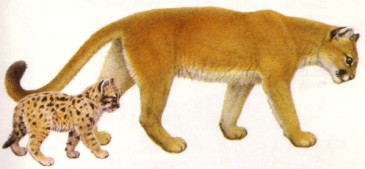
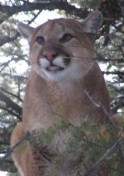
Photo Credit: Houghton Mifflin Company / Undisclosed
The cougar is one of our largest and most powerful predatory animals, exceeded in size only by the bears. Male cougars can weigh up to 90kg (200 pounds). Its body color ranges from tawny brown to grayish brown and the young are spotted all over. The cougar is large and long. Its head is quite small with rounded ears; its long tail is has a dark brown tip.
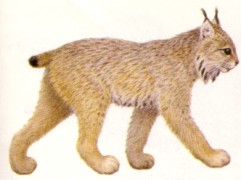
Photo Credit: Houghton Mifflin Company
The lynx is a medium-sized cat with a short body, long legs, very large padded feet and a stubby tail. A ruff surrounds its face. Its ears are pointed and tipped with long, black hairs.
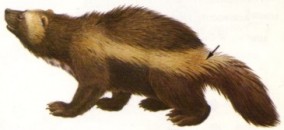
Photo Credit: Houghton Mifflin Company
The wolverine is one of the larger species in the weasel family and can weigh up to 28kg (60 pounds). It looks like a small bear with a bushy tail. It has a muscular body, strong legs and bear-like paws with five claws, suitable for climbing. The wolverine's head is broad, its ears short and rounded, it has small black eyes, and its face tapers to a black muzzle. It has dark brown fur and broad yellow stripes running from each shoulder to the base of its tail.
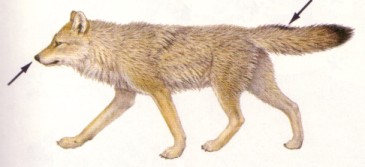
Photo Credit: Houghton Mifflin Company
Wolves are generally much larger than coyotes, about the size of a large German shepherd dog, and travel in packs. A wolf has a larger head, larger paws and a bushier tail than a coyote. The wolf has a broad face, and comes in a range of colors, including gray, black, white and brown.
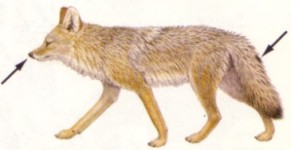
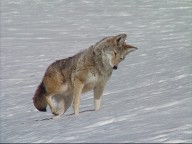
Photo Credit: Houghton Mifflin Company / Waterton Parks
Coyotes are common in the mountains and are often seen hunting mice along roadside ditches. The coyote runs with its tail down, between its hind legs. Coyotes are generally smaller than wolves, with larger ears, and are a grayish-brown shade.
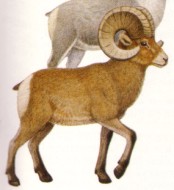
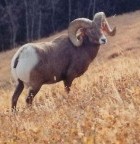
Photo Credit: Houghton Mifflin Company / Undisclosed
Bighorn sheep are great rock climbers and get minerals by licking the soil. They have brown coats, a white rump, and brown horns. Both sexes of bighorn sheep have horns, but the female's horns are smaller.
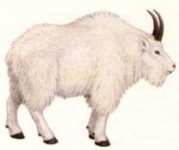
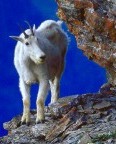
Photo Credit: Houghton Mifflin Company / Waterton Parks
The mountain goat lives on craggy mountain slopes above the treeline. In winter, the goats move down to the lower slopes looking for food. Mountain goats have short legs, shaggy white coats and sharp black horns.
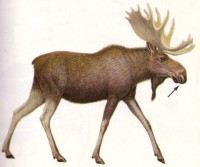
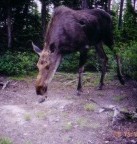
Photo Credit: Houghton Mifflin Company / Miistakis Institute
The moose is the largest member of the deer family, with the bulls being considerably larger than the cows. It has long legs, a stubby tail, high humped shoulders and a long face and snout with a "dewlap", or bell, hanging from its throat. The male has wide, very heavy antlers that look like upturned hands with the fingers spread out. The older males drop their antlers in December or early January, but the younger ones carry them until late February.
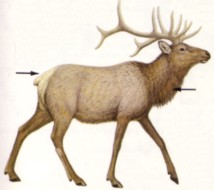
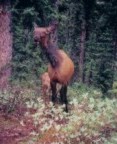
Photo Credit: Houghton Mifflin Company / Miistakis Institute
The elk is one of the largest members of the deer family, second in size only to the moose. Its head and neck are long, and the males have a shaggy neck mane. The elk's legs are moderately long, and its tail short and wedged shaped. Each year the male grows a new set of spreading antlers. Elk often travel in large herds.
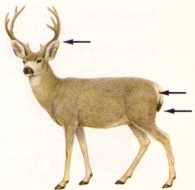
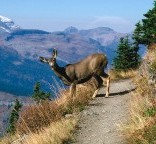
Photo Credit: Houghton Mifflin Company / Waterton Parks
The mule deer is named for its large mule-like ears. Mule deer are larger than white-tailed deer, and have a black tip on the end of their tails.
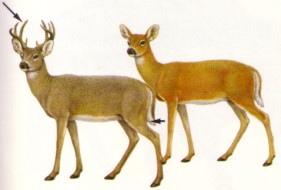
Photo Credit: Houghton Mifflin Company
The white-tailed deer gets its name from the white underside of its tail. This rises up like a flag when the deer is frightened, as the deer leaps away from danger. The whitetail deer has a longer tail than the mule deer, is more slender and has smaller ears and feet.
Illustrations from PETERSON FIRST GUIDE TO MAMMALS OF NORTH AMERICA by Peter C. Alden, illustrated by Richard P. Grossenheider. Copyright 1987 by Houghton Mifflin Company. Reproduced by permission of Houghton Mifflin Company. All rights reserved.